Studio Mumbai (Bijoy Jain)

Copper House II, Chondi, Maharashtra, India, 2010

Copper House II, Chondi, Maharashtra, India, 2010

Palmyra House, Nangaon, Maharashtra, India, 2007

Palmyra House, Nangaon, Maharashtra, India, 2007

Palmyra House, Nangaon, Maharashtra, India, 2007

Palmyra House, Nangaon, Maharashtra, India, 2007

Born 1965, Mumbai, India
Lives and works in Mumbai, India


Bijoy Jain is an architect and founder of Studio Mumbai, a contemporary and award-winning architectural practice drawing on the traditional skills and expertise of India’s craftspeople. Creating a studio where skilled stonemasons, wood workers and other traditional trades do not simply execute his projects but are regarded as advisors and collaborators, Jain has enabled a rediscovery of traditional knowledge and the sustainable use of local resources.

Drawing upon the Indian landscape and regarding it as a resource, Studio Mumbai have created buildings as diverse as private residences, public spaces, research centres and rural retreats formed by local climatic conditions, materials and technologies.

‘An architectural practice almost unique in the world, Studio Mumbai redefines the construction process...’

Andrew Barrie


Venue
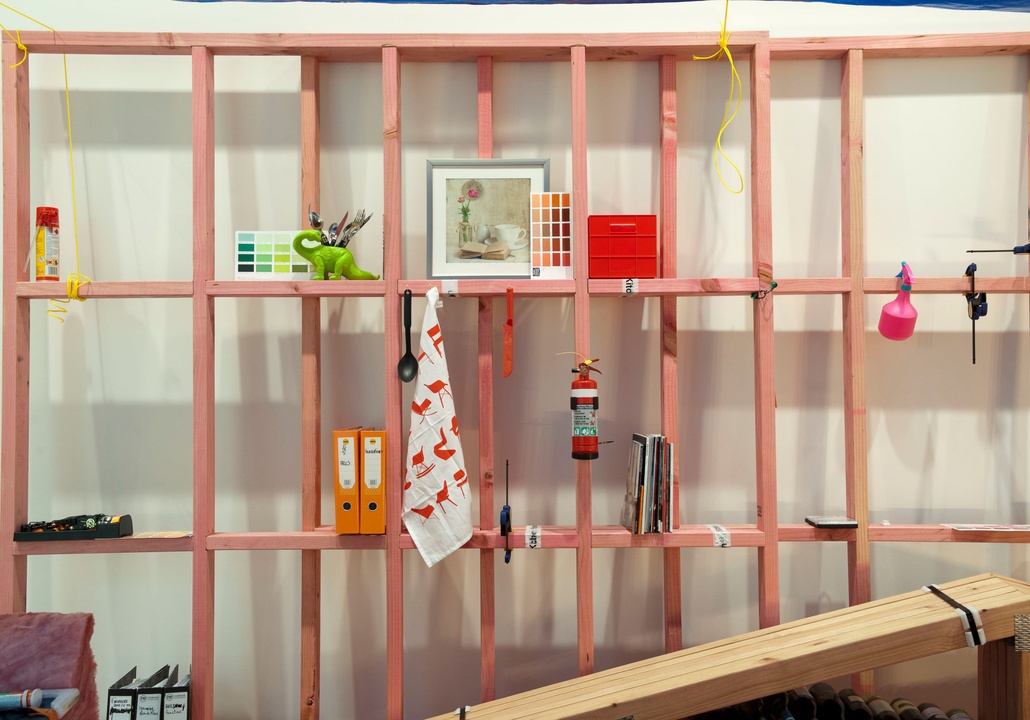
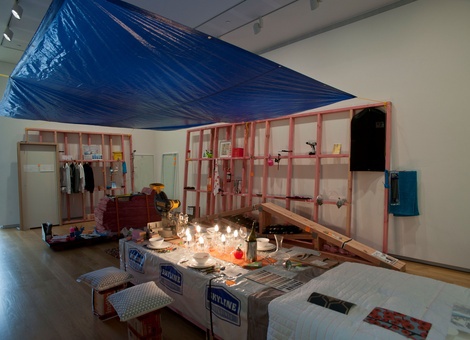
Model Home,2013

Model Home,2013

Andrew Barrie, Okoshi-ezu (Yatsushiro Monument KILALI, Kumiko Inui), 2008. Photo: Patrick Loo

Andrew Barrie, Okoshi-ezu (Yatsushiro Monument KILALI, Kumiko Inui), 2008. Photo: Patrick Loo

Born in Levin, New Zealand in 1968, Dr Andrew Barrie, is an Auckland-based designer and Professor at the School of Architecture and Planning, The University of Auckland. After completing doctoral studies at Tokyo University, he spent several years as a project architect at Toyo Ito & Associates in Tokyo, before returning to Auckland to work at Cheshire Architects. His design work has won numerous awards in New Zealand and Japan. He is the author of several books on Japanese architecture, and is a regular contributor to architecture and design journals.

Barrie's academic research and exhibition practice includes okoshi-ezu, an ancient Japanese architectural drawing technique often associated with teahouse design, which takes the form of annotated folding paper models. He has been adapting this method for use in modeling contemporary buildings, and in Model Home 2013 extends it further to create a one-to-one paper model of Atelier Bow-Wow's workers' house.

Selected exhibitions (solo): Densities, New Work Studio, Wellington, 1996; Code, Artspace, Auckland, 1999; Unfolding the New Japanese Architecture, State Library of Queensland, Brisbane & Objectspace, Auckland, 2010. Selected exhibitions (group): Architecture to a Fault, 5th International Architecture Exhibition, Venice Biennale, 1991; New Zealand Installation, Milan Triennial, 1996; SD Review, Tokyo & Osaka, 1999; Minna no ie, Museum of Contemporary Art, Tokyo, 2012; Familial Clouds, 13th International Architecture Exhibition, Venice Biennale, 2012; Kiwi Prefab: Cottage to Cutting Edge, Puke Ariki, New Plymouth, 2012.

Model Home

2013
Auckland Art Gallery

For the 5th Auckland Triennial Michael Lin and Atelier Bow Wow collaborated with Professor Andrew Barrie from the University of Auckland to create a life-size paper document of worker housing element of the Model Home project, the sound and video artists were Nanli Lou and Ren Cheng. Andrew Barrie is a specialist in the Japanese technique of paper model building known as okoshi-ezu (folding drawing), and has adapted aspects of this technique for Model Home 2013.


Venue
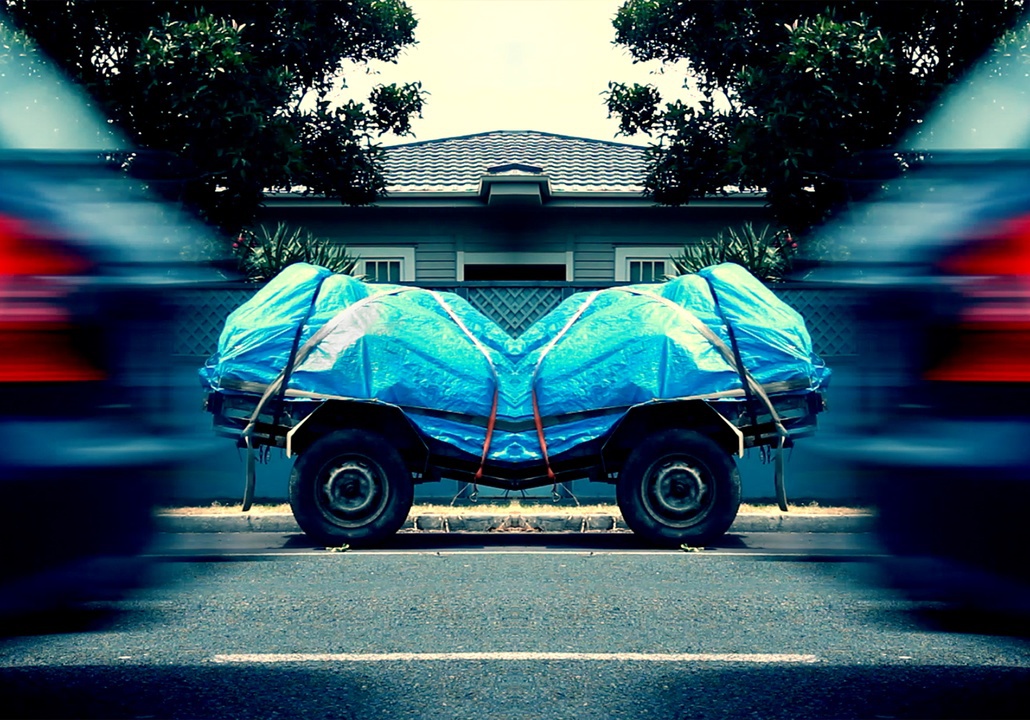
Tropical Thunder,2013

Tropical Thunder,2013

Tropical Thunder,2013

Tropical Thunder,2013

Tropical Thunder,2013

Tropical Thunder,2013

Born 1978, Perth, Australia Lives and works Sydney, Australia

Keg de Souza is an inter-disciplinary artist who works across mediums including video, artist’s books, printmaking, inflatable architecture, installation and drawing. The investigation of spatial politics is central to de Souza’s work, as she focuses not only on the built environment but also social space. De Souza is involved in collaborative artistic projects and groups, such as the SquatSpace artist collective, the collaborative duo You Are Here, the Network of Un-Collectable Artists and the Rizzeria printmaking collective. Under the name All Thumbs Press she publishes hand-bound books and zines featuring her illustrations and writing.

http://www.allthumbspress.net/

Selected exhibitions (solo):

Gonflables et amuse-bouches, Darling Foundry, Montréal, 2012 Living Under the Stars, Urban Art Projects, Brisbane, 2012; Rosen-tales; Women’s Studio Workshop, New York, 2012; Ramble Through The Rocks, Offsite: MCA, Sydney, 2011; Whatever Floats Your Boat, Cockatoo Island Studios to Balmain, Sydney, 2010. Selected exhibitions (group): Social Networking, Gallery of Modern Art, Brisbane, 2012; Primavera 2011: Young Australian Artists, Museum of Contemporary Art, Sydney, 2011; Trama, Museu de Arte Contemporânea de Serralves, Porto, 2011; Designated Drivers, The Block Museum of Contemporary Art, Evanston, Illinois, 2011; The Right to The City (SquatSpace), Tin Sheds Gallery, Sydney, 2011.

'Tropical Thunder ... investigates the commercialisation of traditional practices...’

Anna Davis, Curator, Museum of Contemporary Art, Sydney

Tropical Thunder

2013
Fresh Gallery Otara

plastic tablecloths, fans, bottled soft drink, risograph printed maps
dimensions variable
courtesy of the artist


Venue
Tlatelolco Clash, 2011 (still)

Tlatelolco Clash, 2011 (still)

3-2-1, 2011

3-2-1, 2011

(born 1974) Albania.
Lives and works in Berlin.

Working primarily in film and video, Anri Sala creates works that bring together documentary, history, language and cultural memory. Early films referenced his personal experience and reflected on Albania’s social and political changes, while recent works have explored the tension between repetition and improvisation, often involving or offering the possibility of live performance.

http://www.mariangoodman.com/artists/anri-sala/

Sala’s films and installations disrupt and reconfigure the viewer’s relationship to the image and the space, echoing his approach to making work, which the artist describes as being ‘shaped, inspired and constrained by rupture, and transitory or intermediate stations’.

Selected exhibitions (solo):

Museum De Pont, Tilburg, The Netherlands, 2013; Centre Georges Pompidou, Paris, France, 2012; Serpentine Gallery, London, UK, 2011; About Change Studio, Berlin, Germany, 2010; CAC Contemporary Arts Center, Cincinnati OH, 2009; Museum of Contemporary Art North Miami, USA, 2008; Extra City, Antwerp, Belgium, 2007. Selected exhibitions (group): 2012 Documenta, Kassel, Germany; 9th Gwangju Biennale, China, 2012; Architektonika, Hamburger Bahnhof, Berlin, Germany, 2012; Tribute to Anri Sala, Locarno Film Festival, Italy, 2011; 29th São Paolo Biennale, Brazil, 2010; Haunted: Contemporary Photography/Video/Performance, Guggenheim Museum, New York, 2010; Gender Check, Museum Moderner Kunst Stiftung Ludwig Wien, Vienna, Austria, 2009; The Implications of Image, Museo Universitario de Ciencias y Arte, Mexico City, Mexico, 2008; Moskau Biennale, Moscow, Russia, 2007.

‘Music, emotive and often abstract, is a powerful form of non-verbal communication, and even a catalyst for change.’

Andrew Clifford, Curator, Centre for Art Research, The University of Auckland

Long Sorrow

2005
Gus Fisher Gallery

HD video transferred from super 16mm film, stereo sound
12:57min
courtesy of Johnen Galerie Berlin; Galerie Rüdiger Schöttle, Munich; Marian Goodman Gallery, New York; Hauser & Wirth, Zurich / London; Galerie Chantal Crousel, Paris

Tlatelolco Clash

2011
Gus Fisher Gallery

HD video projection, five-channel surround sound
11:49min
courtesy of kurimanzutto, Mexico City; Marian Goodman Gallery, New York; Hauser & Wirth, Zurich / London; Galerie Chantal Crousel, Paris

3-2-1

2011
Gus Fisher Gallery

live performance featuring artist André Vida responding to the film Long Sorrow
courtesy of the artist


Venue
Model Home,2013

Model Home,2013

Bokutei, 2008

Bokutei, 2008

(formed 1992) Lives and works in Tokyo
Yoshiharu Tsukamoto Born 1965, Kanagawa, Japan
Momoyo Kaijima Born 1969, Tokyo, Japan


Atelier Bow Wow’s practice is based on a thorough study of existing cultural, economic, and environmental conditions and they are most well known for small-scale and idiosyncratic buildings squeezed into tiny sites around Tokyo. Known as ‘pet architecture’, these charming yet highly functional and considered residences reflect a deep understanding of local needs and cultural practices.

Atelier Bow-Wow has also acquired a following through its Micro Public Space projects and the innovative projects at exhibitions such as the 2011 Venice Biennale (as an official representative of Japan) and at the Hayward Gallery in London.

Selected exhibitions:

house inside city outside house, Tokyo Opera City Art Gallery, 2011; 12th Venice Architecture Biennale, 2010; The Gallery at REDCAT, Los Angeles, USA, 2009; 3rd Liverpool Biennial, 2008; 27th São Paulo Biennale, 2006.

Model Home

2012
Auckland Art Gallery

For the 5th Auckland Triennial Michael Lin and Atelier Bow Wow collaborated with Professor Andrew Barrie from the University of Auckland to create a life-size paper document of worker housing element of the Model Home project, the sound and video artists were Nanli Lou and Ren Cheng. Andrew Barrie is a specialist in the Japanese technique of paper model building known as okoshi-ezu (folding drawing), and has adapted aspects of this technique for Model Home 2013.


Venue
Just in time for too late, (2013)

Just in time for too late, (2013)

Just in time for too late, (2013)

Just in time for too late, (2013)

Born 1966, Madeira, Portugal
Lives and works in San Francisco, United States of America

Rigo 23 is an artist interested in the different forms of community-based practice. In the 1990s he painted a number of large-scale Pop Art-inspired murals which highlight world politics and the plight of political prisoners including the "Black Panther Party" and the "Angola Three". Some of Rigo 23’s most memorable murals appear on the sides of buildings, including the large black and white mural One Tree, 1995. In this mural Rigo 23 painted the words ‘one tree’ in a giant traffic arrow which points to a lone tree in a crowded industrial setting – a reminder to the people who pass it of what is lost in urbanisation.

http://www.artistsrespond.org/artists/rigo23/

Selected exhibitions (solo):

Autonomous InterGalactic Space Program, REDCAT Gallery, Los Angeles, 2012; Tate Wikikuwa Museum: North America 2024, Warehouse Gallery, Syracuse University, 2010; The Deeper They Bury Me, the Louder My Voice Becomes, New Museum, New York City, 2009; Cracks in the Highway, MAC – Museu de Arte Conemporânea, Niterói, 2007. Selected exhibitions (group): Autonomous Regions, Times Museum, Guangzhou, 2013; Kochi-Muziris Biennale, Kerala, 2012; Fifty Years of Bay Area Art – the SECA Awards, San Francisco Museum of Modern Art, 2011; The Jerusalem Show IV, East Jerusalem/Ramallah, Palestine, 2010; 10th Lyon Biennale, 2009.

‘A social activist and commentator in his own right, Rigo 23 has an aesthetic that is unpretentious and direct.’

Nigel Borell, Kaiwhakahaere, Toi o Manukau, Auckland Council

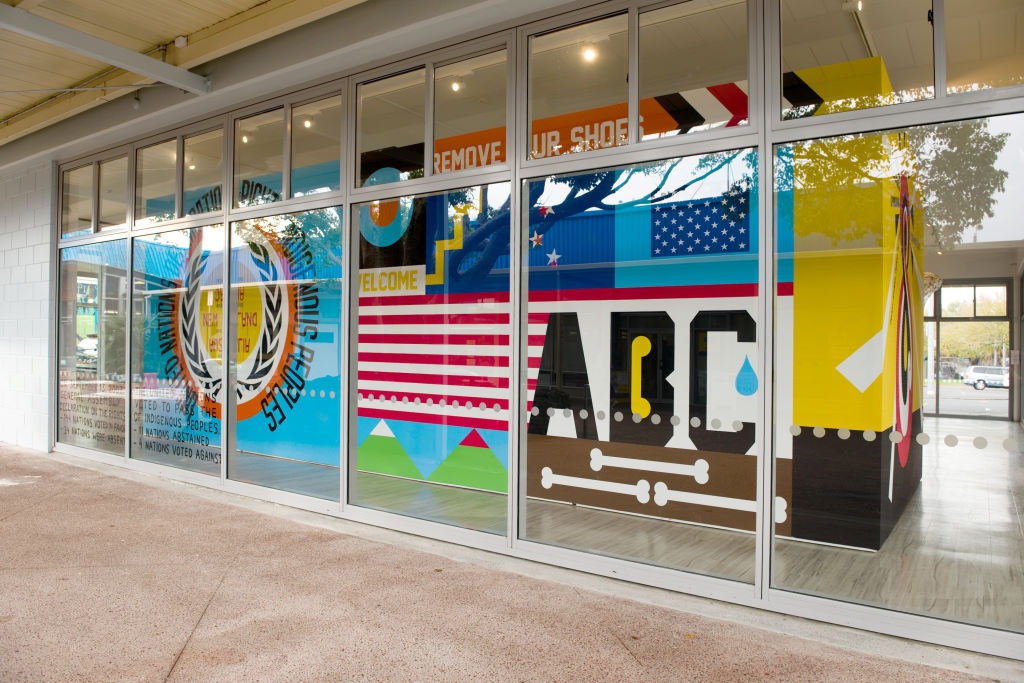
Untitled

2013
Fresh Gallery Otara

Emory Douglas, Rigo 23, Wayne Youle
painted mural
2940 x 11300
Courtesy of the artists


Venue
If You Were To Work Here: the Mood in the Museum, 2013

If You Were To Work Here: the Mood in the Museum, 2013

Born 1966, Ashburton
Lives and works in Auckland, New Zealand

Peter Robinson’s recent work investigates both the materiality and metaphoric potential of his chosen medium. Whether it is the massive weightless volume of polystyrene forms or the densely contracted materiality of felt, Robinson’s sculptural propositions play out various oppositions such as density and lightness, and dispersion and compression. His felt sticks reference the formalist legacies of minimalist, post-minimalist and conceptual art, conflating these iconic art-historical conventions with both traditional Māori abstraction and taonga (treasure) forms, and genetic or binary codes, to activate a contemporary recoding and recontextualisation.

Selected exhibitions (solo): Defunct Mnemonics, Peter McLeavey Gallery Wellington, 2012; Structure and Subjectivity, Sue Crockford Gallery, Auckland, 2012; Essential Security, Sutton Gallery, Melbourne 2011; Modern Standards, Sue Crockford Gallery, Auckland, 2010, Wellington, 2010; The Influence of Anxiety, The Centre for Drawing Project Space, London, 2010; Polymer Monoliths, Artspace, Sydney and Institute of Modern Art, Brisbane, 2009; Snow Ball Blind Time, Govett-Brewster Art Gallery, New Plymouth, 2008; Soft Rock Baroque, Peter McLeavey Gallery, Wellington2008; Concatenation and Dispersion, Sutton Gallery, Melbourne, 2007; ACK!, Artspace, Auckland, NZ, 2006;The Humours, Dunedin Public Art Gallery,2005

Selected exhibitions (group): All our relations, 18th Biennale of Sydney, 2012; De-Building, Christchurch Art Gallery, 2011; The Walters Prize, Auckland Art Gallery, 2008; Three Colours: Gordon Bennett and Peter Robinson, Heide Museum of Modern Art, Melbourne, 2004; Centre of Attraction, 8th Baltic Triennale of International Art, Vilnius 2002; bi-polar, 49th Venice Biennale, 2001.

‘Peter Robinson, at Auckland Museum, reminds us that Conceptual art can jolt viewers into revisiting the perceived and the accepted.’

Marcus Boroughs, Head of Public Programmes, Auckland War Memorial Museum Tamaki Paenga Hira

If You Were To Work Here: the Mood in the Museum

2013
Auckland War Memorial Museum

240 felt-covered aluminium rods
2500 x 32 mm (each), overall dimensions variable
courtesy of the artist and Hopkinson Cundy, Auckland


Venue
Model Home,2013

Model Home,2013

Born 1964, Tokyo, Japan 
Lives and works in Shanghai, China and Brussels, Belgium and Taipei, Taiwan.

Michael Lin is best known for his large-scale colourful floral paintings which cover the facades of building, interiors, windows and furniture. Using patterns from traditional Taiwanese textiles and decorative arts Lin’s work blurs the lines between art and craft, and raises issues around the continuity of traditional and domestic art forms. These playful insertions question the role of art in public space as Lin transgresses the line between the undervalued domestic realm and the dominant public one. Lin has collaborated with architects and local trades people to create environments and structures which encourage new ways of encountering art.

Selected exhibitions (solo):

Model Home, Rockbund Art Museum, Shanghai, 2012; Michael Lin, Free Port No. 005, Peabody Essex Museum, Salem, 2012; Hotel MARCO, Museum of Contemporary Art, Vigo, 2011; A Modest Veil, Vancouver Art Gallery, 2010; Michael Lin, OK Offenes Kulturhaus, Linz, 2007; Michael Lin, Kunsthalle Wien, Vienna, 2005. Selected exhibitions (group): 3rd SingaporeBiennale, 2011; Memories of the Future, Leeum, Samsung Museum of Art, Seoul, 2010; 4th Fukuoka Asian Art Triennale, 2009; Space For Your Future, Museum of Contemporary Art, Tokyo, 2007; Notre Histoire, Palais de Tokyo, Paris, 2006; 2nd Guangzhou Triennial, 2005.

‘... Lin goes out looking for ... anonymous patterns loaded with collective memories.’

Yuko Hasegawa, Chief Curator, Museum of Contemporary Art, Tokyo

Model Home

2013
Auckland Art Gallery

For the 5th Auckland Triennial Michael Lin and Atelier Bow Wow collaborated with Professor Andrew Barrie from the University of Auckland to create a life-size paper document of worker housing element of the Model Home project, the sound and video artists were Nanli Lou and Ren Cheng. Andrew Barrie is a specialist in the Japanese technique of paper model building known as okoshi-ezu (folding drawing), and has adapted aspects of this technique for Model Home 2013.


Venue
Just in time for too late, (2013)

Just in time for too late, (2013)

Just in time for too late, (2013)

Just in time for too late, (2013)

Born 1943, Grand Rapids, United States of America
Lives and works in San Francisco, United States of America

Emory Douglas created the visual identity for the Black Panther Party and his iconic images came to symbolise the struggles of the movement. As Minister of Culture for the "Black Panther Party" from 1967 until the 1980s, Douglas’ work, described as ‘Militant Chic’, featured in most issues of the newspaper The Black Panther. His work is characterised by strong graphic images of young African American men, women and children. He used the newspaper’s popularity to spur people to action, portraying the poor with empathy and as being unapologetic and ready for a fight.

http://www.emorydouglasart.com/

Selected exhibitions (solo):

Black Panther: The Revolutionary Art of Emory Douglas, Urbis, Manchester, 2008–9; Black Panther: The Revolutionary Art of Emory Douglas, MOCA Pacific Design Center, Los Angeles, 2007–8. Selected exhibitions (group): 16th Biennale of Sydney, 2008; The Black Panther Rank and File, Yerba Buena Center for the Arts, San Francisco, 2006.

‘The values of equality, racial economic justice and fairness are just as relevant today as they ever were.’

Nigel Borell, Kaiwhakahaere, Toi o Manukau, Auckland Council

Untitled

2013
Fresh Gallery Otara

Emory Douglas, Rigo 23, Wayne Youle
painted mural
2940 x 11300
Courtesy of the artists


Venue
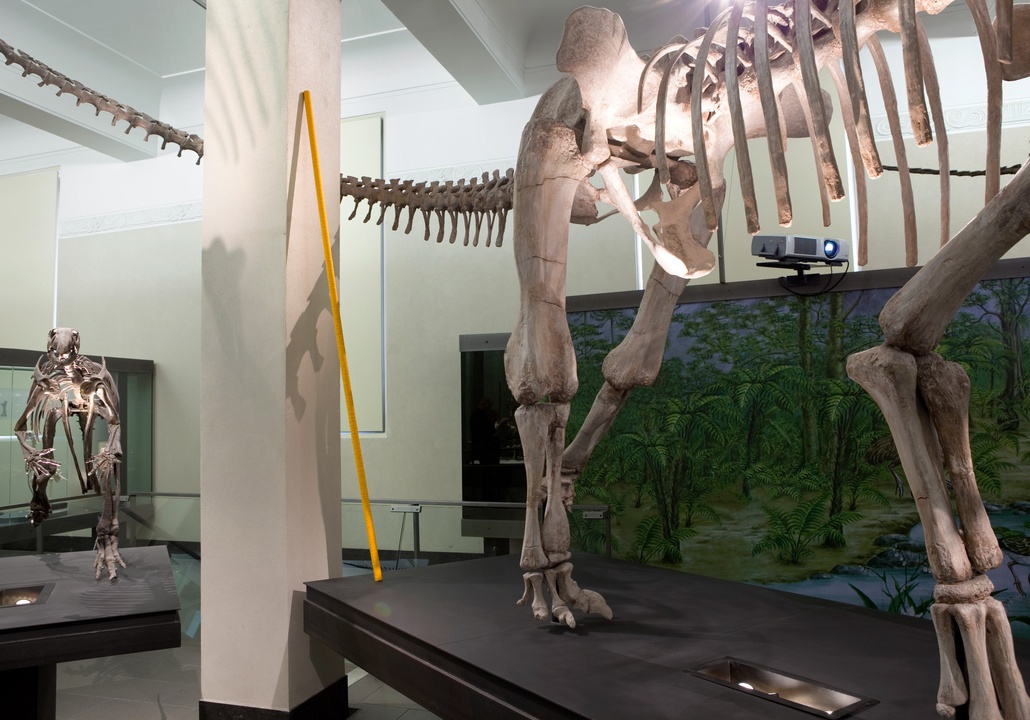
The Most Difficult Problem, 2013 (still)

The Most Difficult Problem, 2013 (still)

Text from J Bronte Gatenby, 'The New Zealand Glow-Worm' (Tuatara, vol 8, no. 2, 1960)

Text from J Bronte Gatenby, 'The New Zealand Glow-Worm' (Tuatara, vol 8, no. 2, 1960)

Born 1970, Auckland, New Zealand
Lives and works in Wellington, New Zealand

Maddie Leach’s practice is project-based, conceptually driven and frequently involves research into the specifics of the site in which she is working. With her interest in the development of new thinking in relation to social, place-based and process-driven artwork,Leach’s early work held a central position in New Zealand’s relational aesthetics practice. While no longer overtly participatory, her work continues to explore ideas of spectatorship, expectation and strategies of cooperation in the production of art works. Leach’s recent projects often operate beyond the walls of the gallery and focus on constructing complex arrangements between space, time, place and audience.

Campaign to re-open tunnels under Auckland's Albert Park - 3 News

Selected exhibitions (group):

Between Memory and Trace, Te Tuhi Centre for the Arts, Auckland, 2012; Peripheral Relations: Marcel Duchamp and New Zealand Art, Adam Art Gallery, Wellington, 2012; The Obstinate Object, City Gallery Wellington, 2012; Iteration: Again, CAST, Tasmania, 2011; Collecting Contemporary, Museum of New Zealand Te Papa Tongarewa, Wellington, 2011; Reason and Rhyme, Gertrude Contemporary, Melbourne, 2011; Close Encounters, Hyde Park Art Center, Chicago, 2010; One Day Sculpture, Wellington, 2008; Trans Versa, The South Project, Santiago, 200

Leach’s practice weaves narrative threads to connect propositions, actions, and materials. Her sculptural diffusions of matter and imagination challenge the idea of the ‘sculptural object’.

Jem Noble, artist, Bristol and Vancouver

The Most Difficult Problem

2013
Auckland Art Gallery

single-channel colour HD video projection, sound, text on newsprint
piano: Paul Lincke’s Glüwürmchenidyll performed and uploaded to YouTube by Markus Andreas Mayer
print design by Warren Olds
courtesy of artist