Venue
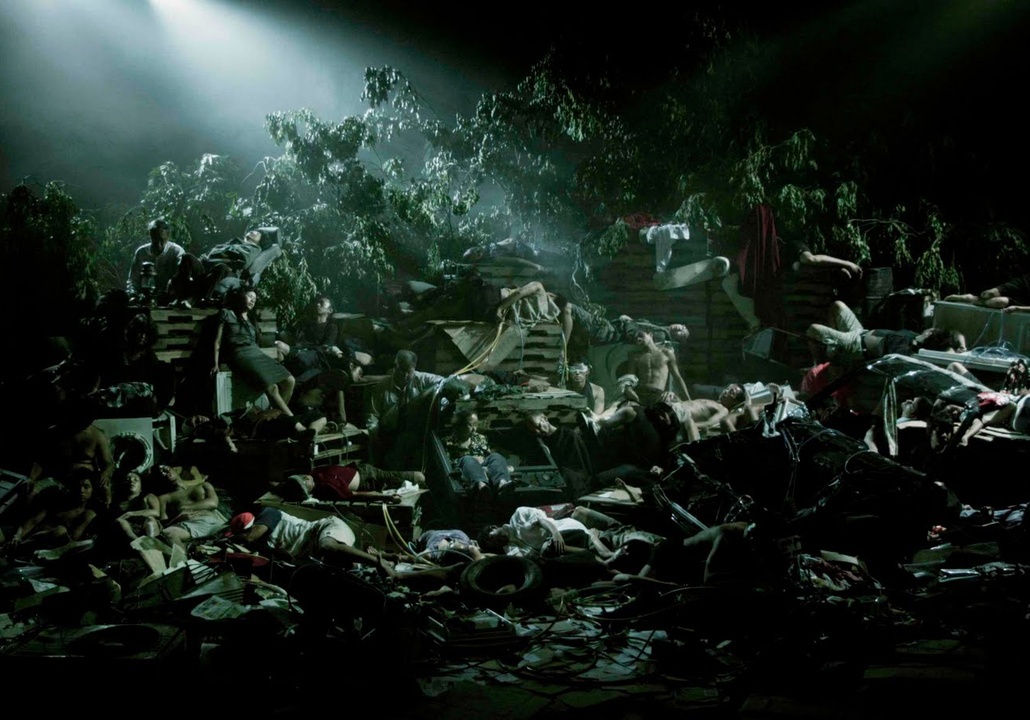
Barricade # 2 (Mitroviça dans la partie serbe de la ville), Kosovo, 7 avril 2012

Barricade # 2 (Mitroviça dans la partie serbe de la ville), Kosovo, 7 avril 2012

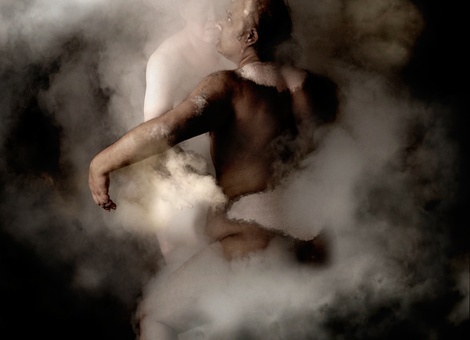
Au nord de Mitroviça sur la route menant à la Serbie, Kosovo, 8 avril 2012

Au nord de Mitroviça sur la route menant à la Serbie, Kosovo, 8 avril 2012

Born 1968, Châtellerault, France
Lives and works in Paris, France

Bruno Serralongue’s images show the lesser events on the margins of major events and provide alternatives to the linear narrative of news reports of photo essays. Employing a photojournalistic technique Bruno Serralongue has captured important long-lasting geo-political conflicts in countries including Kosova, Sudan and Tibet as well as concerts, summits, forums, and demonstrations. His recent bodies of work reveal the effects of globalisation on those in developing countries.

http://www.brunoserralongue.com/

Selected exhibitions (solo):

South Sudan Series, Francesca Pia gallery, Zurich, 2013; Histoire des avant-dernières luttes, Air de Paris Gallery, Paris, 2012; Feu de camp, Jeu de Paume, Paris, 2010, Bruno Serralongue, Wiels, Brussels, 2009; Backdraft, Centre of Photography, Geneva, 2007. Selected exhibitions (group): Newtopia, The State of Human Right, Mechelen, Belgium, 2012; Oceans and Campfires: Allan Sekula and Bruno Serralongue, San Francisco Art Institute, 2011; Project Europa – Imagining the (Im)possible, Harn Museum of Art, Florida, 2010; Uneven Geographies, Nottingham Contemporary, 2010; Street & Studio: An Urban History of Photographic Portraiture, Tate Modern, London, 2008; 6th Gwangju Biennale, 2006

’[Serralongue] affirms that the only objectivity we have today is an artistic objectivity.’

Pascal Beausse

1998-1999, musée du Kosovo, Pristina, septembre

2009
Artspace

Ilfochrome print mounted on aluminium, frame with glass
1270 x 1590 mm
courtesy of the artist and Air de Paris, Paris

«Travaillons ensemble», Pristina, Kosovo, 8 novembre

2010
Artspace

Ilfochrome print mounted on aluminium, frame with glass
1270 x 1590 mm
courtesy of the artist and Air de Paris, Paris

Locations Artspace 1998-1999, musée du Kosovo, Pristina, septembre 2009 Artspace Ilfochrome print mo

2011
Artspace

Ilfochrome print mounted on aluminium, frame with glass
1270 x 1590 mm
courtesy of the artist and Kadist Art Foundation, Paris

Barricade # 2 (Mitroviça dans la partie serbe de la ville), Kosovo, 7 avril

2012
Artspace

Ilfochrome print mounted on aluminium, frame with glass
1270 x 1590 mm
courtesy of the artist and Kadist Art Foundation, Paris

«Kosovo is serbian Alamo», barricade # 2, Mitroviça, Kosovo, 7 avril

2012
Artspace

Ilfochrome print mounted on aluminium, frame with glass
520 x 630 mm
courtesy of the artist and Air de Paris, Paris

Au nord de Mitroviça sur la route menant à la Serbie, Kosovo, 8 avril

2012
Artspace

Ilfochrome print mounted on aluminium, frame with glass
520 x 630 mm
courtesy of the artist and Air de Paris, Paris

Journaliers (Bosch), Pristina, Kosovo, 11 avril

2012
Artspace

diptych, Ilfochrome print mounted on aluminium, frame with glass

520 x 630 mm
courtesy of the artist and Air de Paris, Paris

Journalier (Bosch), Pristina, Kosovo, 11 avril

2012
Artspace

llfochrome print mounted on aluminium, frame with glass
520 x 630 mm
courtesy of the artist and Air de Paris, Paris

Journaliers (bûcherons), Mitroviça, Kosovo, 9 avril

2012
Artspace

Ilfochrome print mounted on aluminium, frame with glass
520 x 630 mm
courtesy of the artist and Air de Paris, Paris


Venue
Architectural plans with notes for the removal and acquisition of garage doors from Mahia Road, Manurewa

Architectural plans with notes for the removal and acquisition of garage doors from Mahia Road, Manurewa

Born 1988, Auckland
Lives and works in Auckland, New Zealand

Luke Willis Thompson’s art deals with sites and objects that embody a sense of historical, political or social trauma. In recent work the artist has used ready-made objects – such as a local funeral home’s art collection and a house in the Auckland suburb of Epsom – to trace the faultlines of race and class in his chosen context. Thompson sets up estranging encounters where the viewer is confronted with an object both ontologically and in the space of narrative and mythology.

Selected exhibitions (solo):

inthisholeonthisislandwhereiam, Hopkinson Cundy, Auckland, 2012; Yaw, RM, Auckland, 2011. Selected exhibitions (group): Between memory and trace, Te Tuhi Centre for the Arts, Pakuranga, 2012; In Spite of Ourselves: Approaching Documentary, St Paul St Gallery, Auckland and The Dowse Art Museum, Lower Hutt, 2012; Make\Shift: Tautai’s Third Tertiary Show, St Paul St Gallery, Auckland, 2010.

‘... objects that shatter any achievable fantasy of community...’

Danny Butt, writer and artist, Melbourne

Untitled

2012
Auckland Art Gallery

three garage doors, security lights
dimensions variable
courtesy of the artist and Hopkinson Cundy, Auckland


Venue
Model Home,2013

Model Home,2013

Andrew Barrie, Okoshi-ezu (Yatsushiro Monument KILALI, Kumiko Inui), 2008. Photo: Patrick Loo

Andrew Barrie, Okoshi-ezu (Yatsushiro Monument KILALI, Kumiko Inui), 2008. Photo: Patrick Loo

Born in Levin, New Zealand in 1968, Dr Andrew Barrie, is an Auckland-based designer and Professor at the School of Architecture and Planning, The University of Auckland. After completing doctoral studies at Tokyo University, he spent several years as a project architect at Toyo Ito & Associates in Tokyo, before returning to Auckland to work at Cheshire Architects. His design work has won numerous awards in New Zealand and Japan. He is the author of several books on Japanese architecture, and is a regular contributor to architecture and design journals.

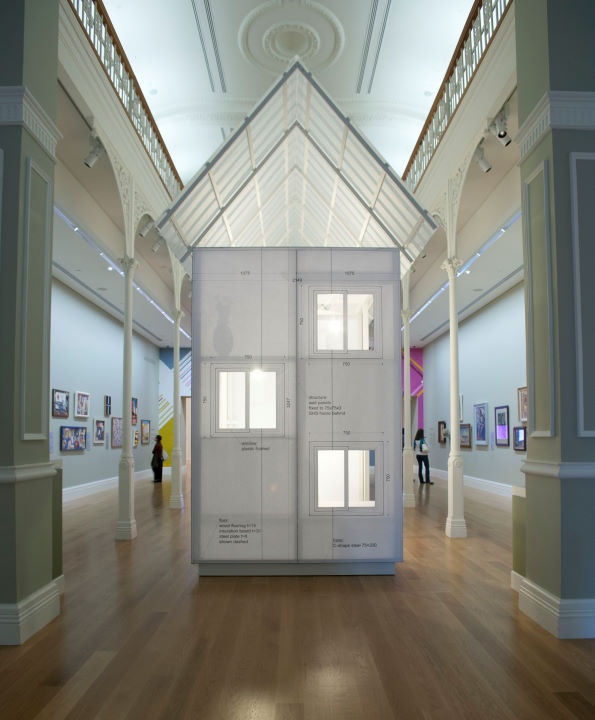
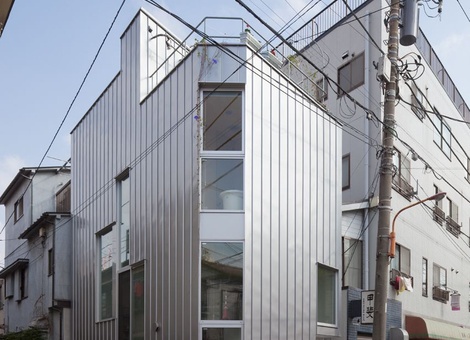
Barrie's academic research and exhibition practice includes okoshi-ezu, an ancient Japanese architectural drawing technique often associated with teahouse design, which takes the form of annotated folding paper models. He has been adapting this method for use in modeling contemporary buildings, and in Model Home 2013 extends it further to create a one-to-one paper model of Atelier Bow-Wow's workers' house.

Selected exhibitions (solo): Densities, New Work Studio, Wellington, 1996; Code, Artspace, Auckland, 1999; Unfolding the New Japanese Architecture, State Library of Queensland, Brisbane & Objectspace, Auckland, 2010. Selected exhibitions (group): Architecture to a Fault, 5th International Architecture Exhibition, Venice Biennale, 1991; New Zealand Installation, Milan Triennial, 1996; SD Review, Tokyo & Osaka, 1999; Minna no ie, Museum of Contemporary Art, Tokyo, 2012; Familial Clouds, 13th International Architecture Exhibition, Venice Biennale, 2012; Kiwi Prefab: Cottage to Cutting Edge, Puke Ariki, New Plymouth, 2012.

Model Home

2013
Auckland Art Gallery

For the 5th Auckland Triennial Michael Lin and Atelier Bow Wow collaborated with Professor Andrew Barrie from the University of Auckland to create a life-size paper document of worker housing element of the Model Home project, the sound and video artists were Nanli Lou and Ren Cheng. Andrew Barrie is a specialist in the Japanese technique of paper model building known as okoshi-ezu (folding drawing), and has adapted aspects of this technique for Model Home 2013.

Venue
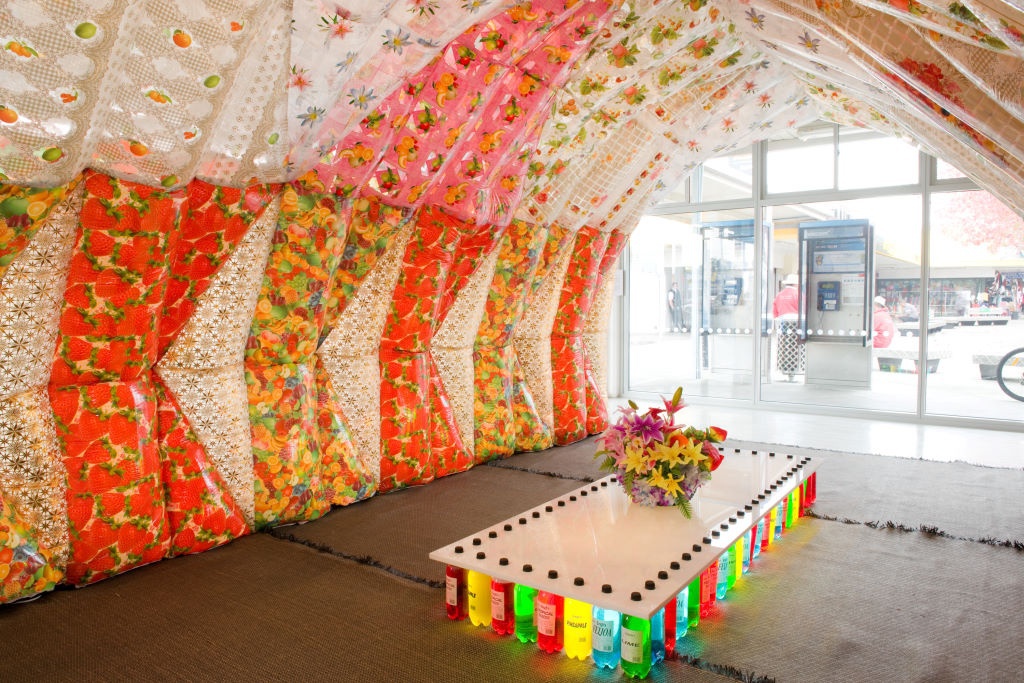
Tropical Thunder,2013

Tropical Thunder,2013

Tropical Thunder,2013

Tropical Thunder,2013

Tropical Thunder,2013

Tropical Thunder,2013

Born 1978, Perth, Australia Lives and works Sydney, Australia

Keg de Souza is an inter-disciplinary artist who works across mediums including video, artist’s books, printmaking, inflatable architecture, installation and drawing. The investigation of spatial politics is central to de Souza’s work, as she focuses not only on the built environment but also social space. De Souza is involved in collaborative artistic projects and groups, such as the SquatSpace artist collective, the collaborative duo You Are Here, the Network of Un-Collectable Artists and the Rizzeria printmaking collective. Under the name All Thumbs Press she publishes hand-bound books and zines featuring her illustrations and writing.

http://www.allthumbspress.net/

Selected exhibitions (solo):

Gonflables et amuse-bouches, Darling Foundry, Montréal, 2012 Living Under the Stars, Urban Art Projects, Brisbane, 2012; Rosen-tales; Women’s Studio Workshop, New York, 2012; Ramble Through The Rocks, Offsite: MCA, Sydney, 2011; Whatever Floats Your Boat, Cockatoo Island Studios to Balmain, Sydney, 2010. Selected exhibitions (group): Social Networking, Gallery of Modern Art, Brisbane, 2012; Primavera 2011: Young Australian Artists, Museum of Contemporary Art, Sydney, 2011; Trama, Museu de Arte Contemporânea de Serralves, Porto, 2011; Designated Drivers, The Block Museum of Contemporary Art, Evanston, Illinois, 2011; The Right to The City (SquatSpace), Tin Sheds Gallery, Sydney, 2011.

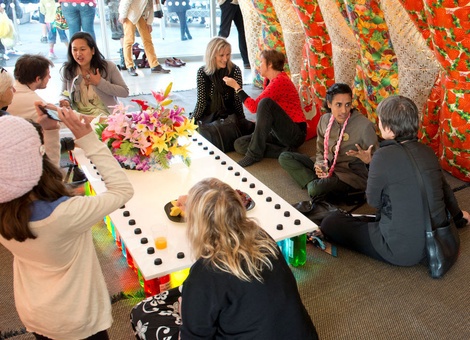
'Tropical Thunder ... investigates the commercialisation of traditional practices...’

Anna Davis, Curator, Museum of Contemporary Art, Sydney

Tropical Thunder

2013
Fresh Gallery Otara

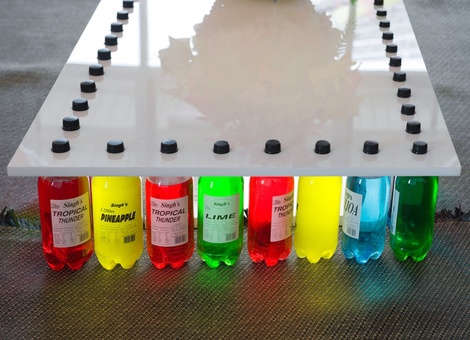
plastic tablecloths, fans, bottled soft drink, risograph printed maps
dimensions variable
courtesy of the artist


Venue
A Perfect Home: The Bridge Project, 2010 (video still)

A Perfect Home: The Bridge Project, 2010 (video still)

A Perfect Home: The Bridge Project, 2010 (video still)

A Perfect Home: The Bridge Project, 2010 (video still)

(born 1962) Seoul, South Korea
Lives and works in New York, London and Seoul.

Do-Ho Suh’s sculptures and installations explore spatial dynamics and issues of cultural difference. His site-specific installations act like microcosms of the postmodern, globalised world, questioning the boundaries of identity in relation to public and private space. Suh’s work, which draws from his Korean background and life in the West, addresses the place of individual and collective identities in a global society. Through the use of architectural elements and references to the body, Suh evokes a trans-cultural life where the dynamics of space, culture and connection create unanticipated form.

Selected exhibitions (solo):

Hiroshima MOCA, Hiroshima, Japan, 2012; Leeum Samsung Museum, Seoul, South Korea, 2012; Tate Modern, London, UK, 2011; Storefront for Art and Architecture, New York, USA, 2010; 2001 Venice Biennale, Italy. Selected exhibitions (group):Luminous: The Art of Asia, Seattle Art Museum, 2011; 2010 Liverpool Biennial, Liverpool, UK; 2010 Venice Architecture Biennale, Italy; Your Bright Future: 12 Contemporary Artists from Korea, Los Angeles County Museum of Art, USA, 2009; Psycho Buildings, Hayward Gallery London, UK, 2008.

‘... there is no freedom in architecture. In fact freedom is a ruse Suh points to...’

Yasmeen M Siddiqui, curator and essayist, Louisville, Kentucky.

A Perfect Home: The Bridge Project

2010
Auckland Art Gallery

synchronised four-monitor animated digital slide presentation, two single-channel videos, sound
11:00min
© Do Ho Suh
courtesy of the artist


Venues
test pattern [live set], 2008, photograph by Liz Hingley

test pattern [live set], 2008, photograph by Liz Hingley

A [for 6 silos]

A [for 6 silos]

Born 1966, Gifu, Japan
Lives and works in Paris, France

Ryoji Ikeda is one of Japan’s leading electronic composers and visual artists who successfully works across both visual and sonic media. His work involves elaborate orchestrations of sound, visuals and mathematical notions which explore the characteristics of sound and result in immersive live performances and installations.

http://www.ryojiikeda.com/

Alongside his musical pieces, Ikeda continues to work on long-term projects including test pattern, 2008–ongoing in which he developed a system that converts any type of data – text, sounds, photographs and movies – into barcode patterns and binary notation consisting of 0s and 1s.

Selected exhibitions:

Beam In Thine Own Eye, Museum of Old and New Art, Hobart, 2013, test pattern [no5], Carriageworks, Sydney, 2013; test pattern [ 100m version],Ruhr Trienniale, Duisburg, 2013; Ryoji Ikeda, DHC-ART, Montréal, 2012; The Transfinite, Park Avenue Armory, New York, 2011; datamatics, Museo de Arte, Bogota, Colombia. His performances datamatics [v.2], test pattern [live set] and superposition have been presented all over the world including Pompidou Centre, Paris, Tate Modern, London and Palazzo Grassi, Venice.

‘[Ikeda’s] projects ... are sensational, beautiful and challenging.’

Hou Hanru, Curator, 5th Auckland Triennial

A [for 6 silos]

2013
SIlo 6

site-specific six-channel sound installation
continuous loop
courtesy of the artist

test pattern [live set]

2013
Galatos

audiovisual concert
concept, composition: Ryoji Ikeda
computer graphics, programming: Tomonaga Tokuyama


Venue
Paranoid Structures, 2013 (still)

Paranoid Structures, 2013 (still)

Paranoid Structures, 2013 (still)

Paranoid Structures, 2013 (still)

Born 1972, Auckland, New Zealand
Lives and works in Auckland, New Zealand

Auckland-based artist Tahi Moore works across a range of media including video, sculpture, painting and performance. Moore’s installations typically unfold and collapse around a central text offered to the viewer through subtitles in his video works. Moore’s narratives combine elements from a range of curiously linked sources (with myriad references from philosophy, literature, film, and popular culture more generally) in quietly absurd sequences. These stories typically evince the artist's long-standing fascination with narrative structure, in particular stories of failure, fakes, and moments where meaning is misunderstood, misconstrued or mistranslated.

Selected exhibitions (solo):

Abstract sequels, returns, Hopkinson Cundy, Auckland, 2012; Nonsuch Park, Hopkinson Cundy, Auckland, 2011; Failed Purchases, High Street Project, Christchurch, 2010; War against the self, Gambia Castle, Auckland, 2009; Various Failures, Gambia Castle, Auckland, 2008; German Sands, Our Faces, Gambia Castle, Auckland, 2007; Selected exhibitions (group): Metaphoria, St Paul St Gallery, Auckland 2012; Caraway Downs, Artspace, Auckland, 2011; No Soul For Sale: A Festival of Independents, Tate Modern, London, 2010; Pickups, Magic Mountain, Home, Okay, A pretty intense long drawn out game (with Fiona Connor), Y3K Gallery, Melbourne, 2009.

’... Moore... provides viewers with a selection of visual and sonic clues to decipher the turn of events.’

Caterina Riva

various, astral travels, politics, human, unavoidability of becoming someone else, progress

2013
Gus Fisher Gallery

various dimensions and materials

Conny Plank, Studios, Personal

2013
Gus Fisher Gallery

HD Video, colour, non-concurrent

Sound

6:00min

The only true problem is that nothing needs to be done, Dior runway shows

2013
Gus Fisher Gallery

HD video, colour

5:00min


Venue
If You Were To Work Here: the Mood in the Museum, 2013

If You Were To Work Here: the Mood in the Museum, 2013

Born 1966, Ashburton
Lives and works in Auckland, New Zealand

Peter Robinson’s recent work investigates both the materiality and metaphoric potential of his chosen medium. Whether it is the massive weightless volume of polystyrene forms or the densely contracted materiality of felt, Robinson’s sculptural propositions play out various oppositions such as density and lightness, and dispersion and compression. His felt sticks reference the formalist legacies of minimalist, post-minimalist and conceptual art, conflating these iconic art-historical conventions with both traditional Māori abstraction and taonga (treasure) forms, and genetic or binary codes, to activate a contemporary recoding and recontextualisation.

Selected exhibitions (solo): Defunct Mnemonics, Peter McLeavey Gallery Wellington, 2012; Structure and Subjectivity, Sue Crockford Gallery, Auckland, 2012; Essential Security, Sutton Gallery, Melbourne 2011; Modern Standards, Sue Crockford Gallery, Auckland, 2010, Wellington, 2010; The Influence of Anxiety, The Centre for Drawing Project Space, London, 2010; Polymer Monoliths, Artspace, Sydney and Institute of Modern Art, Brisbane, 2009; Snow Ball Blind Time, Govett-Brewster Art Gallery, New Plymouth, 2008; Soft Rock Baroque, Peter McLeavey Gallery, Wellington2008; Concatenation and Dispersion, Sutton Gallery, Melbourne, 2007; ACK!, Artspace, Auckland, NZ, 2006;The Humours, Dunedin Public Art Gallery,2005

Selected exhibitions (group): All our relations, 18th Biennale of Sydney, 2012; De-Building, Christchurch Art Gallery, 2011; The Walters Prize, Auckland Art Gallery, 2008; Three Colours: Gordon Bennett and Peter Robinson, Heide Museum of Modern Art, Melbourne, 2004; Centre of Attraction, 8th Baltic Triennale of International Art, Vilnius 2002; bi-polar, 49th Venice Biennale, 2001.

‘Peter Robinson, at Auckland Museum, reminds us that Conceptual art can jolt viewers into revisiting the perceived and the accepted.’

Marcus Boroughs, Head of Public Programmes, Auckland War Memorial Museum Tamaki Paenga Hira

If You Were To Work Here: the Mood in the Museum

2013
Auckland War Memorial Museum

240 felt-covered aluminium rods
2500 x 32 mm (each), overall dimensions variable
courtesy of the artist and Hopkinson Cundy, Auckland


Studio Mumbai (Bijoy Jain)

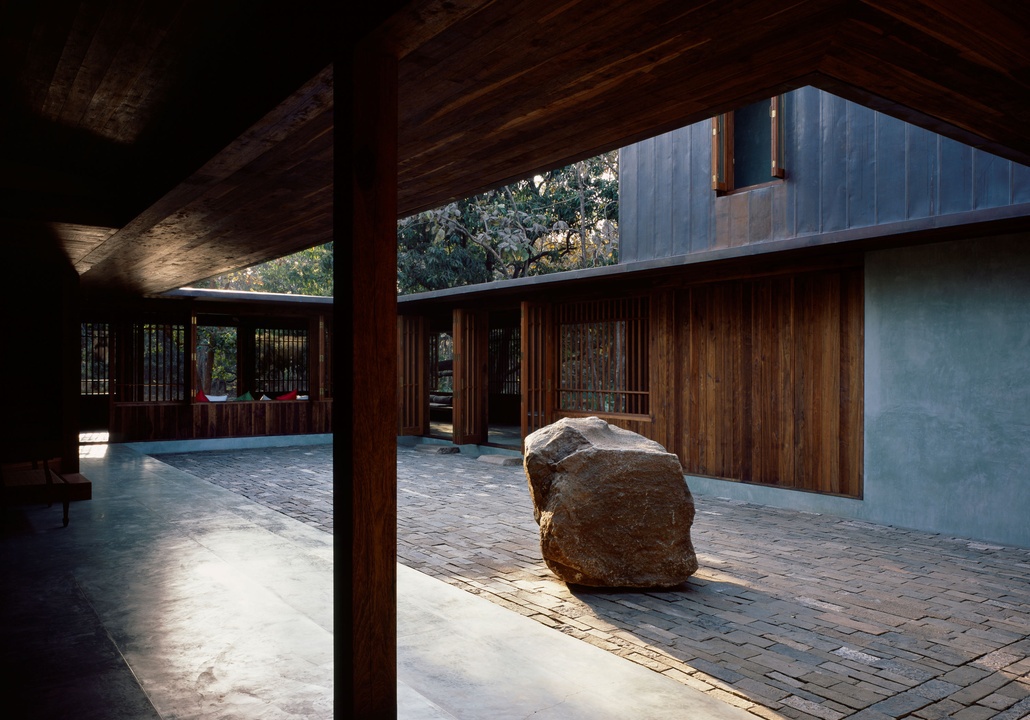
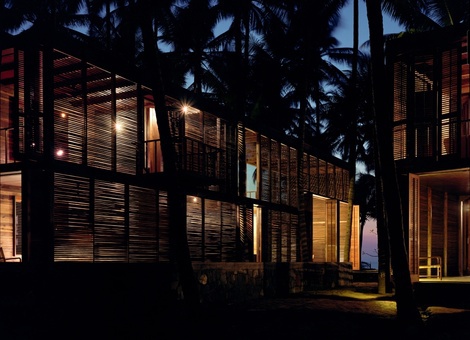
Copper House II, Chondi, Maharashtra, India, 2010

Copper House II, Chondi, Maharashtra, India, 2010

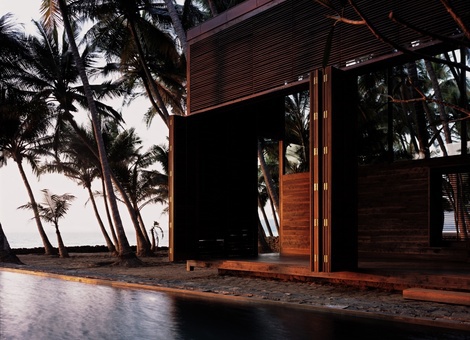
Palmyra House, Nangaon, Maharashtra, India, 2007

Palmyra House, Nangaon, Maharashtra, India, 2007

Palmyra House, Nangaon, Maharashtra, India, 2007

Palmyra House, Nangaon, Maharashtra, India, 2007

Born 1965, Mumbai, India
Lives and works in Mumbai, India


Bijoy Jain is an architect and founder of Studio Mumbai, a contemporary and award-winning architectural practice drawing on the traditional skills and expertise of India’s craftspeople. Creating a studio where skilled stonemasons, wood workers and other traditional trades do not simply execute his projects but are regarded as advisors and collaborators, Jain has enabled a rediscovery of traditional knowledge and the sustainable use of local resources.

Drawing upon the Indian landscape and regarding it as a resource, Studio Mumbai have created buildings as diverse as private residences, public spaces, research centres and rural retreats formed by local climatic conditions, materials and technologies.

‘An architectural practice almost unique in the world, Studio Mumbai redefines the construction process...’

Andrew Barrie


Venue
Under Discussion, 2005 (video still)

Under Discussion, 2005 (video still)

Returning a Sound, 2004 (video still)

Returning a Sound, 2004 (video still)

(formed 1995) Live and work Puerto Rico

Jennifer Allora
Born 1974, Philadelphia, United States of America
James Calzadilla
Born 1971, Havana, Cuba

Collaborating since 1995, Jennifer Allora and Guillermo Calzadilla have produced an experimental and interdisciplinary body of work, combining performance, sculpture, video and sound. Their Land Mark, 2001–ongoing, project focuses on what the artists describe as the ‘transitional geography’ of Vieques, an inhabited island municipality of Puerto Rico used by the U.S Navy as a weapons-testing range from 1941 to 2003.

http://www.lissongallery.com/#/artists/allora-and-calzadilla/

Interested in questions of social justice the artists set into motion a series of structural couples – inscription and erasure, presence and absence, appearance and disappearance – which link processes of mark-making with counter-memorial claims for rights and justice vis-à-vis specific sites.

Selected exhibitions (solo):

Stop, Repair, Prepare, MoMA, New York, 2010, and Haus der Kunst, Munich, 2008; Allora & Calzadilla, National Museum of Art, Oslo, 2009; Compass & How to Appear Invisible, Temporare Kunsthalle, Berlin, 2009; Never Mind That Noise you Heard, Stedekijk Museum, Amsterdam; Allora & Calzadilla, Kunsthalle Zürich, 2007; Clamor, Serpentine Gallery, London, 2007; Wake Up, The Renaissance Society, Chicago, 2007. Selected exhibition (group): 54th Venice Biennale, 2011.

Half Mast\Full Mast

2010
Auckland Art Gallery

dual-channel HD colour video projection
21:11min
courtesy of the artists and Lisson Gallery